
J.W. Strom and the Bowdoin Square Museum
For a brief period of less than three years, J.W. Strom ran the Bowdoin Square Museum from the Parkman Building in Bowdoin Square. More of an enclosed carnival sideshow than our notion of a modern day museum, Strom’s venue offered Bostonians the most sensational entertainment 5 cents could buy.
At the dawn of the 20th century, Bowdoin Square was well into its transformation from Boston’s most desirable residential neighborhood to an extension of the Scollay Square entertainment district. Since 1892, the successful Bowdoin Square Theater had been showing some of the most popular stage acts of the era. In the summer of 1900, an enterprising young man from Virginia introduced a much more exotic form of amusement to the area.
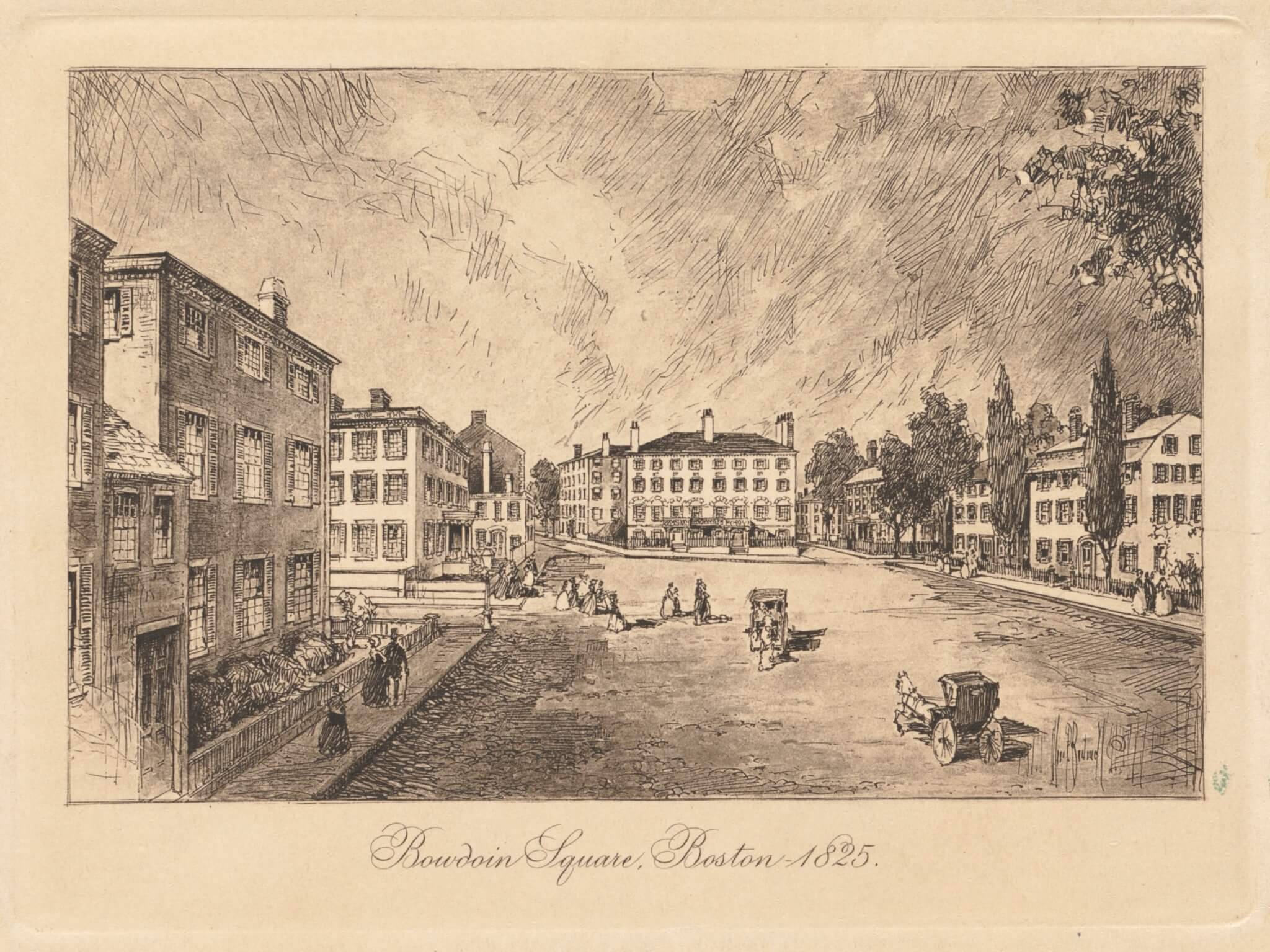
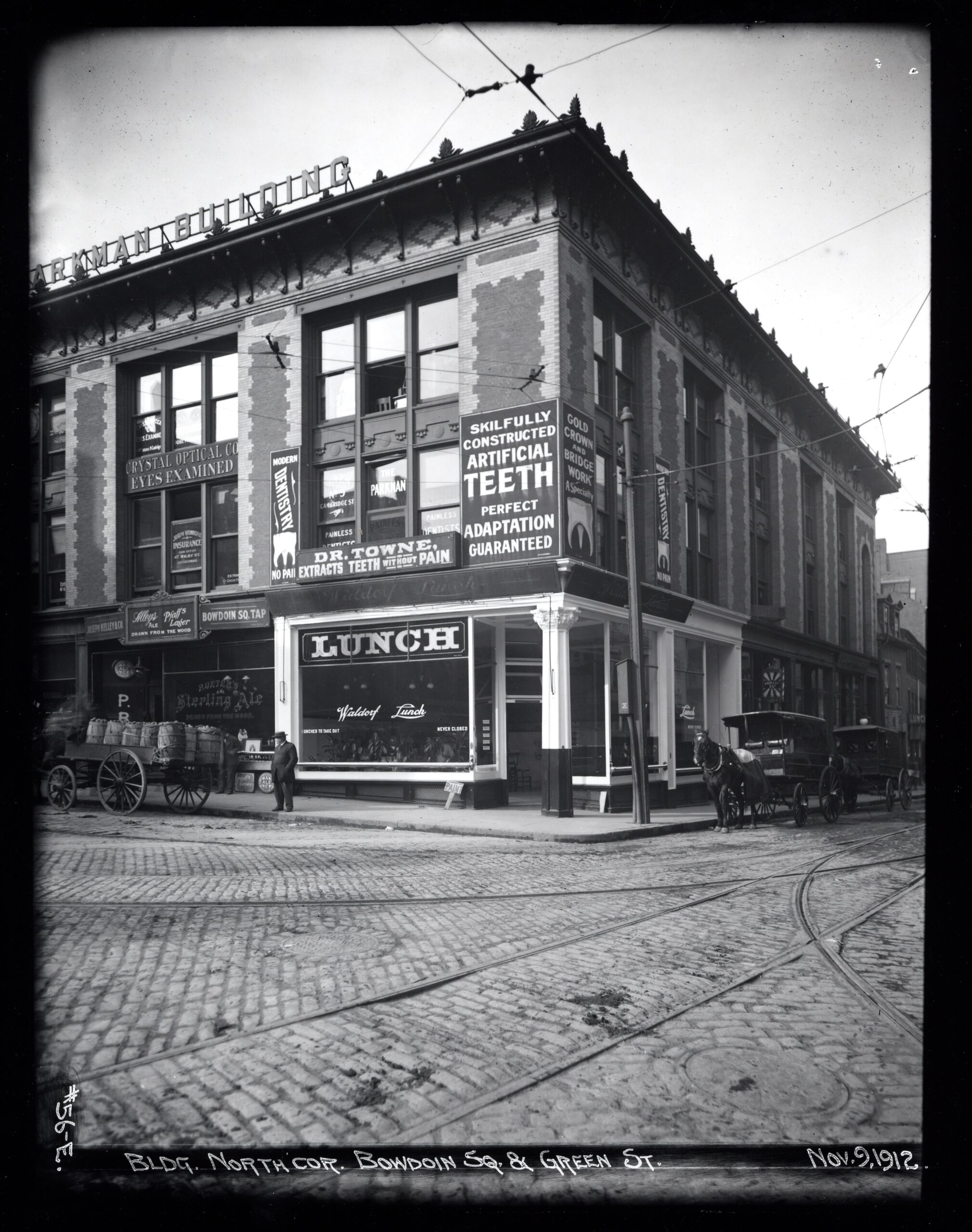
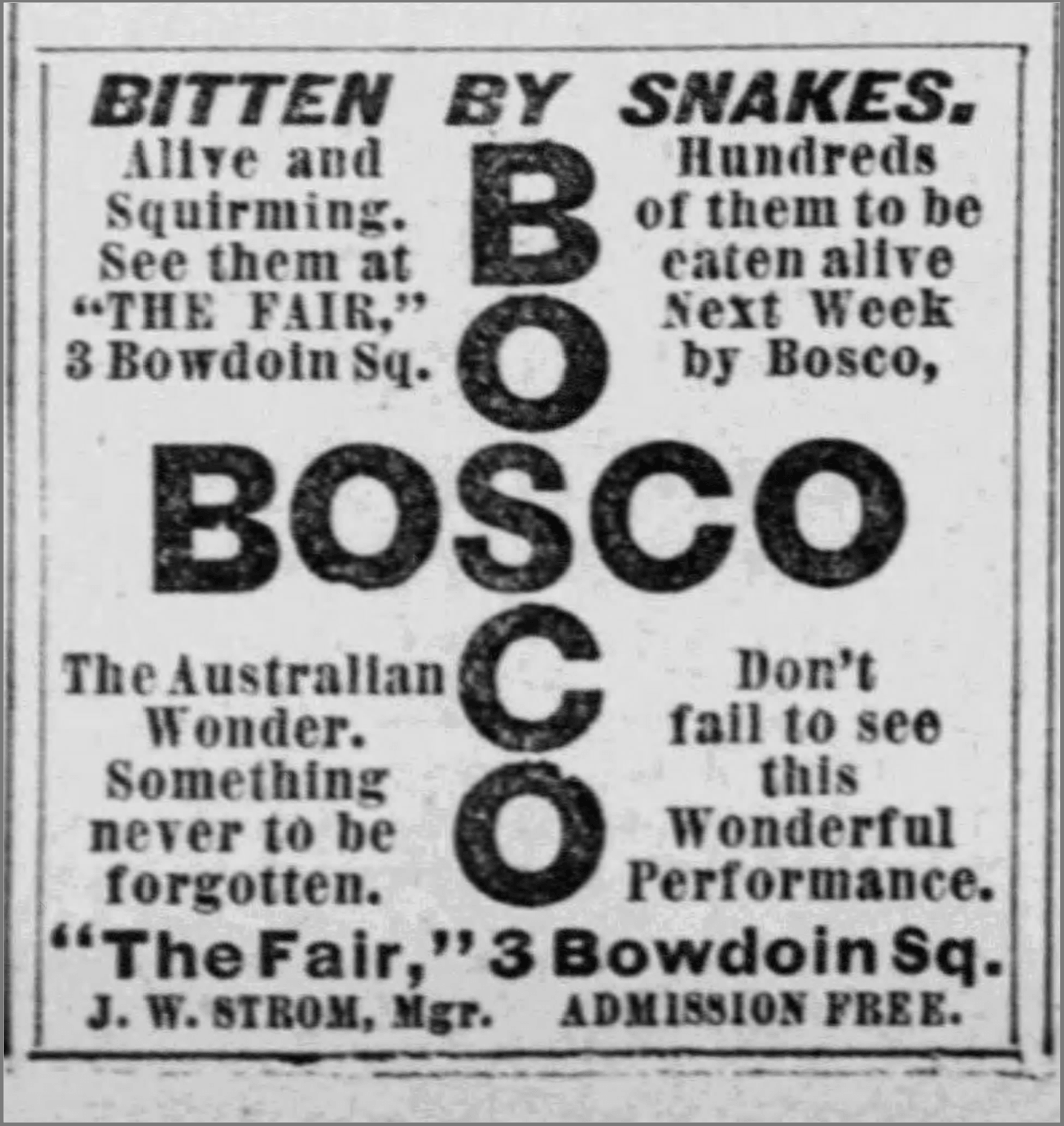
John W. Strom was born in Virginia in 1861 and records show that he lived with his wife and children in East Boston as early as 1895. The family later relocated to McLean Court behind the Boston Lying in Hospital in the West End. On July 22, 1900, Strom appeared in a Boston Globe ad as the proprietor of The Fair at 3 Bowdoin Square. This address was the site of the Parkman Building, a commercial property which replaced the granite mansions of the prosperous Parkman family in the late 19th century. Strom’s first ad promoted free admission to see Bosco, an Australian female performer who bit the heads off of snakes and then ate them alive. On the same day, Strom ran a wanted classified in the Globe seeking “10,000 snakes of all kinds” to support the act.
Strom changed the name of The Fair to the Bowdoin Square Museum, and for the next two and a half years he offered an amazing array of alternative acts for 5 cents admission. He featured everything from burlesque to contortionists, horse mounted combat to animal tricks, and female impersonators to hypnotists. Some of his most eye-catching acts were: Harry Harrison, the Human ostrich who ate anything; Marion Alecia, the only albino actress; Cramer the Human Giraffe; The Rice Brother Pig Circus; Professor Merrill and his Diving Dog; and Sober Sue, the woman who would not smile. The list went on!
On August 4,1901, Strom staged an act that attracted the attention of the Boston Police. On that night, Professor Wilmot A. Barclay hypnotized a West Indian man named Parker A. Johnson, who Strom then buried alive in the basement of the Museum. Three days later, Boston Police, having received reports of the act, confronted Strom at the Museum and demanded that Johson be “disinterred at once” from his temporary grave. Strom refused the order and the officers eventually left with Johnson still lying underground. Thankfully, the Boston Globe reported that Johnson was “exhumed” as planned on August 12, 1901. He claimed to be in good health after the ordeal.
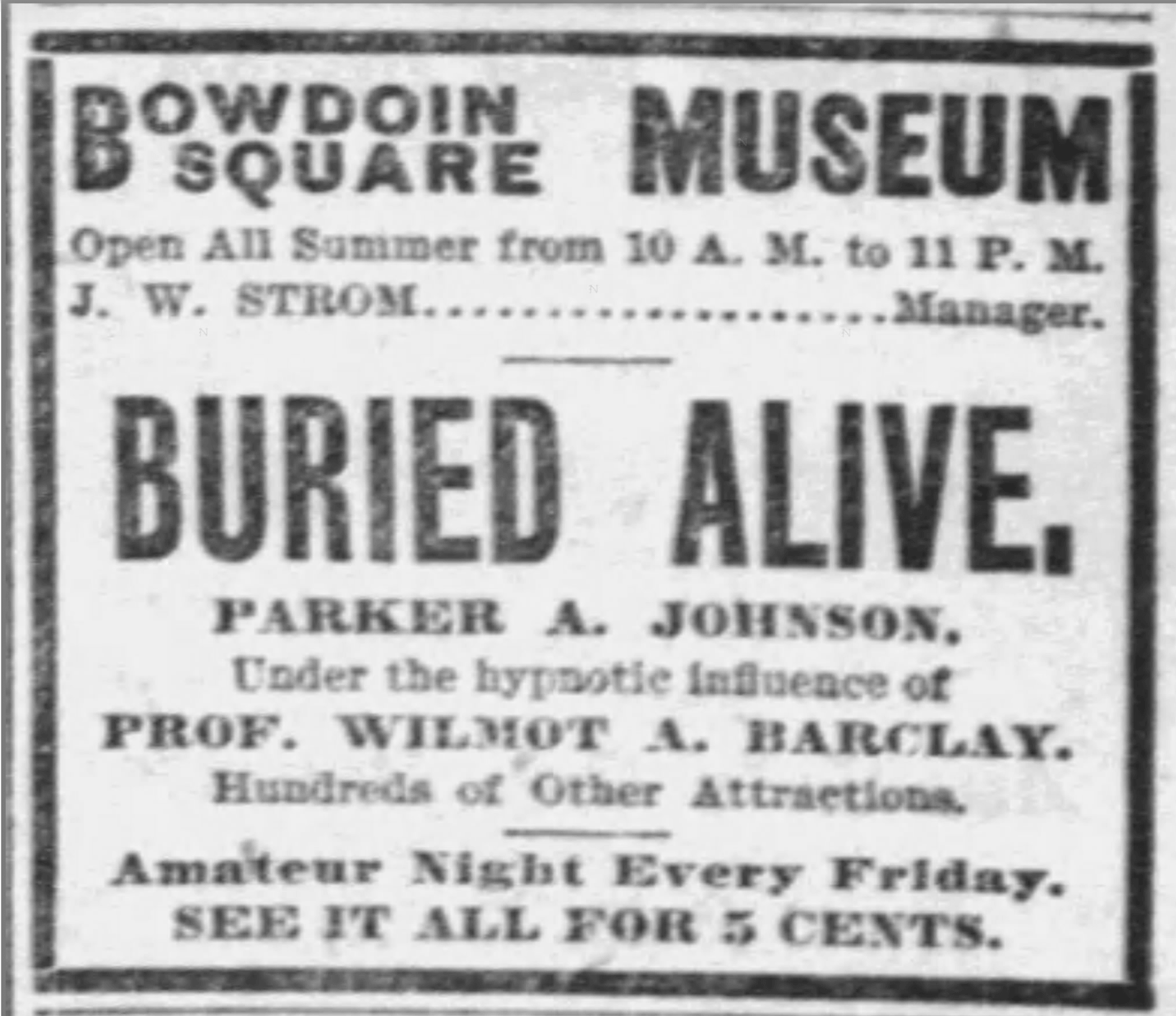
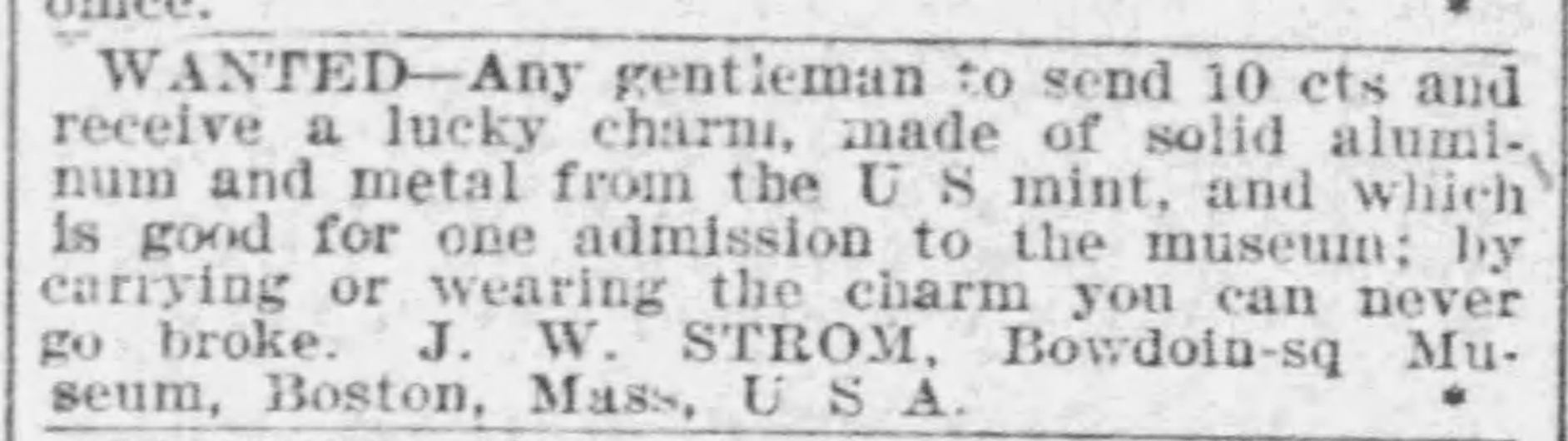
Throughout his ownership of the Bowdoin Square Museum, Strom ran a number of odd classified ads that directly or indirectly promoted his entertainment. He would seek men and women to inexplicably send him stamps in exchange for admission tickets. Storm reported the loss of a diamond pin and two tickets to his museum. If found, he said the person could keep the pin but asked for the return of the tickets. Strom also posted an ad offering an aluminum charm for 10 cents: good for one admission to the Museum and protection from debt. He also placed an unusual ad in 1902 for 1,000 pounds of cheap coal that he would purchase and then give away to the needy.
Strom ran the Bowdoin Square Museum until early 1903, surviving a fire in February of 1902 that nearly shut it down. He filed for bankruptcy in April of 1903 with a debt of over $2,000 and no assets. Strom and his family eventually moved to 53 Ash Ave in Somerville, MA, and it is unclear how Strom made a living after closing his museum. He does reappear in the news, however, as drama followed the former theater manager throughout his life.
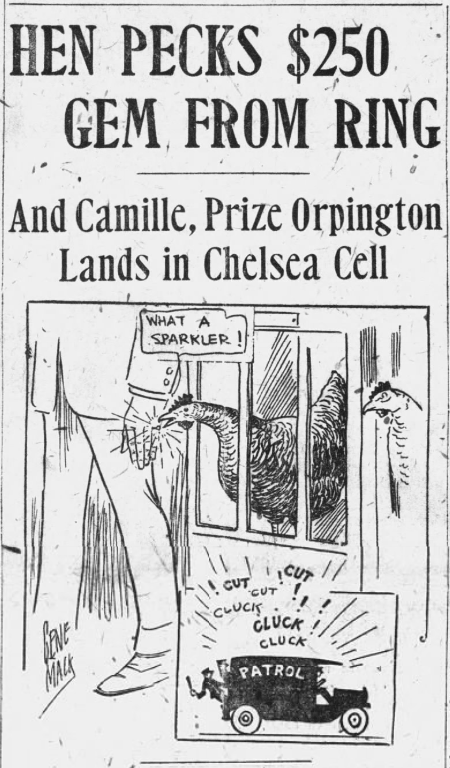
The Boston Globe reported that Strom was seriously injured in an automobile accident in 1918, but he survived. He began collecting and raising hens, including a rare Blue Orpington hen named Camille. Strom’s purchase of this rare bird involved him in an incident as odd as one of his former acts. In December of 1923, Strom displayed Camille at the Eastern Massachusetts Poultry and Pigeon Association show in Chelsea, MA. When a bird admirer named George A. Hennessy got too close to Camille, she plucked a $250 diamond off of his gold ring and swallowed it. This landed Camille in the Chelsea jail for over two weeks, as Strom, Hennessy and the court system tried to work out a solution. Options included killing Camille to retrieve the gem, or operating on her to save both the diamond and her life. Fortunately a bird enthusiast solved the problem by buying Camille from Strom, and paying Hennessy $250 for his lost stone.
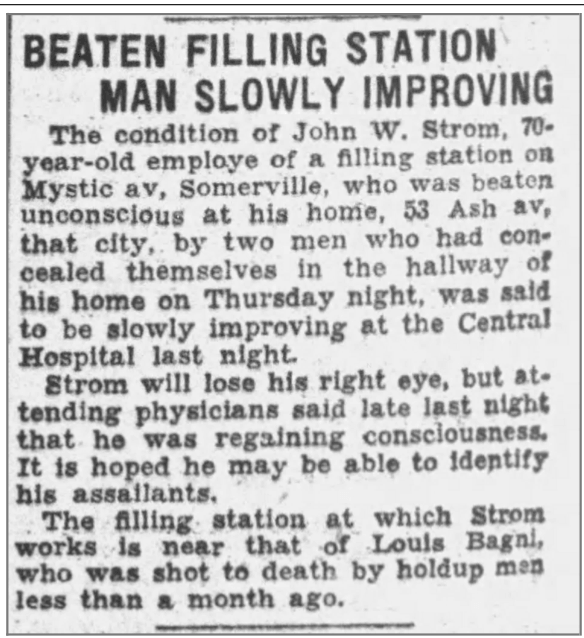
Drama, and tragedy, plagued Strom into his 70s. In March of 1931, two thieves ambushed Strom and severely beat him. He survived the attack but lost an eye. At the time, Strom was working at a local gas station on Mystic Avenue, at the age of 76, possibly an indicator that life had not become easy for the retired theater man. The former owner of the Bowdoin Square Museum and its bizarre shows died in 1937. It is likely that his final resting place is in the Odd Fellows plot in Worcester’s Hope Cemetery.
Article by Bob Potenza, edited by Jaydie Halperin
Sources: Boston City Archives; Boston Globe; Boston Public Library; Find a Grave.